Language

A custom acrylic magnet looks simple. It is a small, glossy, colorful object that sticks to a refrigerator or a metal display board. But behind that simple appearance is a layered product with several material and component decisions that determine its appearance, its durability, and its cost. The acrylic sheet determines the clarity and the scratch resistance. The printing method determines the color vibrancy and the image detail. The magnetic backing determines the holding strength. The adhesive determines whether the layers stay together over time. For a procurement manager sourcing Acrylic Magnets for a promotional campaign, a retail chain, or a souvenir line, understanding these components is the difference between a product that delights the end user and one that peels apart or loses its grip. This guide is written for buyers who need to specify custom acrylic magnets with confidence.
We will walk through the materials and components that are commonly used in Acrylic Magnets, the role each one plays, the options available, the performance trade-offs, and the criteria for evaluating a supplier. We will also provide detailed product parameters from our factory at Wenzhou Kaloge Crafts Co., Ltd. Whether you are ordering a small batch for an event or a large production run for a retail program, this guide will help you select the right combination of materials and components for your application.
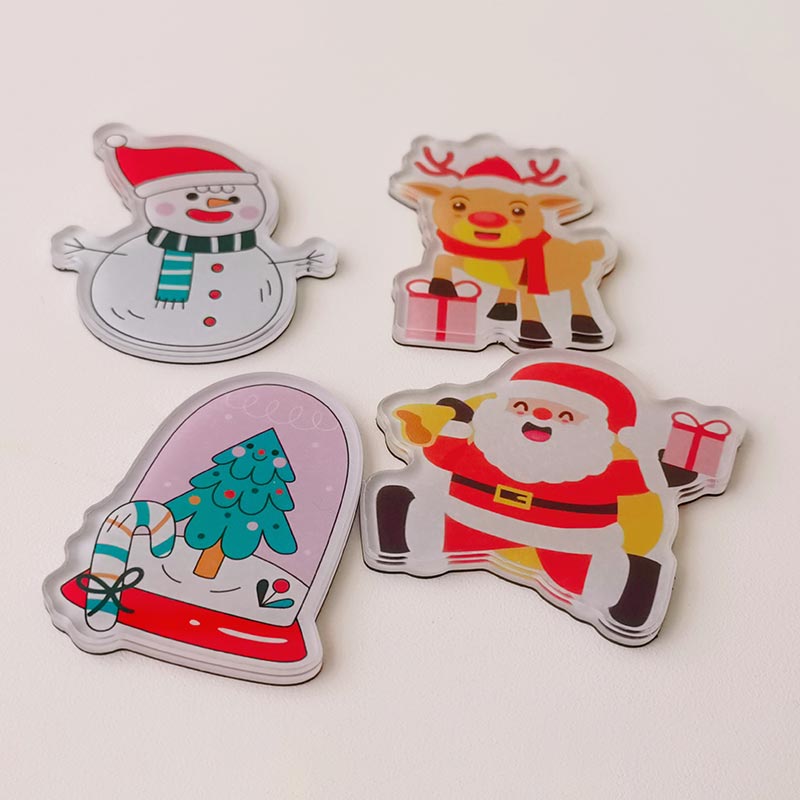
A custom acrylic magnet is a laminated product. It consists of a top layer of clear or colored acrylic, a printed image layer, and a magnetic backing layer. The layers are bonded together with an adhesive. The top acrylic layer protects the printed image and gives the magnet its glossy, premium appearance. The printed image layer carries the design, which can be a logo, a photograph, a promotional message, or a decorative pattern. The magnetic backing layer provides the holding force that keeps the magnet attached to a metal surface. The adhesive bonds the layers and must remain stable over time. The table below summarizes the basic structure of a custom acrylic magnet.
| Layer | Material | Function |
| Top Layer | Clear or colored acrylic sheet | Protects image, provides gloss and scratch resistance |
| Image Layer | Printed paper, vinyl, or direct UV print | Carries the design |
| Adhesive Layer | Pressure-sensitive adhesive or epoxy | Bonds the layers |
| Magnetic Backing | Flexible magnetic sheet or rigid magnet | Provides holding force |
At Wenzhou Kaloge Crafts Co., Ltd., our factory produces custom Acrylic Magnets using this layered construction. We select the acrylic sheet, the printing method, the adhesive, and the magnetic backing based on the customer's requirements for appearance, durability, and cost. Our goal is to provide a magnet that meets the specific needs of each application.
The acrylic sheet is the most visible component of a custom acrylic magnet. It determines the clarity, the gloss, the scratch resistance, and the UV stability of the product. There are two main types of acrylic sheet: extruded and cast. Extruded acrylic is produced by pushing melted acrylic through a die. It is less expensive and is available in large sheets. Cast acrylic is produced by pouring liquid acrylic into a mold. It is more expensive, but it has better optical clarity, better scratch resistance, and better machinability. For a premium custom acrylic magnet, cast acrylic is the better choice. The table below compares the two types.
| Property | Extruded Acrylic | Cast Acrylic |
| Optical Clarity | Good | Excellent |
| Scratch Resistance | Moderate | Good |
| Cost | Lower | Higher |
| Machinability | Good | Excellent |
| Best Suited For | Economy magnets | Premium magnets |
At our factory, we offer both extruded and cast acrylic for our Acrylic Magnets. We recommend cast acrylic for applications where clarity and durability are important, such as souvenir magnets and premium promotional items. For high-volume, cost-sensitive applications, extruded acrylic may be suitable. Our team can help you select the right grade for your project.
The printing method determines the color vibrancy, the image detail, and the durability of the design on a custom acrylic magnet. The most common methods are offset printing, screen printing, digital printing, and UV printing. Offset printing is cost-effective for large volumes and provides good color accuracy. Screen printing is suitable for simple designs with solid colors. Digital printing is cost-effective for small volumes and allows for full-color, high-detail images. UV printing is a digital method that cures the ink instantly with UV light, producing a durable, high-gloss finish. The table below compares these printing methods.
| Method | Best For | Color Quality | Durability | Cost |
| Offset Printing | Large volume, complex designs | Excellent | Good | Medium (high setup) |
| Screen Printing | Simple designs, solid colors | Good | Excellent | Low (high volume) |
| Digital Printing | Small volume, full-color images | Excellent | Good | Low (no setup) |
| UV Printing | Small to medium volume, durable finish | Excellent | Excellent | Medium |
At Wenzhou Kaloge Crafts Co., Ltd., our factory offers all these printing methods for our Acrylic Magnets. We work with our customers to select the method that best fits their design, their volume, and their budget. Our goal is to provide a printed image that meets the customer's expectations for color and durability.
The magnetic backing is the component that makes the acrylic magnet functional. It must provide enough holding force to keep the magnet attached to a metal surface, while being thin enough to keep the magnet lightweight and easy to handle. The two main options are flexible magnetic sheet and rigid magnet. Flexible magnetic sheet is made from a mixture of magnetic powder and a rubber or plastic binder. It is thin, lightweight, and can be cut to any shape. Rigid magnet is made from a solid magnetic material, such as neodymium or ferrite. It provides a stronger holding force but is thicker and heavier. The table below compares the two options.
| Property | Flexible Magnetic Sheet | Rigid Magnet |
| Holding Force | Moderate | High |
| Thickness | 0.5 - 1.0 mm | 2 - 5 mm |
| Weight | Light | Heavy |
| Cost | Low | High |
| Best Suited For | Standard fridge magnets | Heavy magnets, strong hold |
At our factory, we use flexible magnetic sheet for most of our Acrylic Magnets because it is lightweight, cost-effective, and provides sufficient holding force for typical refrigerator and display board applications. For larger or heavier magnets, we can specify a rigid magnet. Our team can help you select the right magnetic backing for your application.
The adhesive is the component that holds the layers of a custom acrylic magnet together. It must bond the acrylic sheet, the printed image, and the magnetic backing without delaminating over time. The most common adhesives are pressure-sensitive adhesive (PSA) and epoxy. PSA is a thin, double-sided tape that bonds instantly under pressure. It is easy to apply and is suitable for most indoor applications. Epoxy is a two-part adhesive that cures to a strong, durable bond. It is more resistant to heat and moisture than PSA. The table below compares the two adhesives.
| Property | Pressure-Sensitive Adhesive | Epoxy |
| Bond Strength | Good | Excellent |
| Heat Resistance | Moderate | High |
| Moisture Resistance | Moderate | High |
| Application | Easy (peel and stick) | Requires mixing and curing |
| Best Suited For | Indoor magnets | Outdoor or high-humidity magnets |
At Kaloge, our factory uses pressure-sensitive adhesive for most of our Acrylic Magnets because it is efficient and suitable for typical indoor use. For magnets that will be exposed to heat or moisture, we use epoxy to ensure a durable bond. Our goal is to provide magnets that stay together over their service life.
Evaluating a supplier of custom Acrylic Magnets requires a focus on material quality, printing capability, magnetic backing options, and quality control. The supplier must use high-quality acrylic sheet, provide accurate printing, and offer the right magnetic backing for the application. They must have a quality control system that checks the adhesion, the print quality, and the magnetic strength of every batch. The table below summarizes the evaluation criteria.
| Evaluation Criterion | What to Look For | Why It Matters |
| Material Quality | Cast or extruded acrylic, certified | Ensures clarity and durability |
| Printing Capability | Offset, screen, digital, UV | Ensures color accuracy and detail |
| Magnetic Backing | Flexible or rigid, tested holding force | Ensures the magnet stays attached |
| Quality Control | Adhesion test, print check, magnetic strength test | Ensures consistent quality |
| Project Experience | Promotional, retail, souvenir references | Demonstrates capability and reliability |
At our factory, we have been producing custom Acrylic Magnets for over a decade. We use high-quality acrylic, offer a range of printing methods, and test the adhesion and magnetic strength of every batch. We invite you to evaluate us against these criteria and to consider us as your partner for Acrylic Magnets.
The following table provides the key product parameters for our custom Acrylic Magnets. These magnets are suitable for promotional, retail, and souvenir applications. Our factory can also produce custom magnets to meet specific requirements.
| Parameter | Specification Range | Notes |
| Acrylic Thickness | 2 - 5 mm | Cast or extruded |
| Magnet Size | Custom | Any shape or size |
| Printing Method | Offset, Screen, Digital, UV | Selected for design and volume |
| Magnetic Backing | Flexible sheet (0.5 - 1.0 mm) or rigid magnet | Selected for holding force |
| Adhesive | PSA or epoxy | Selected for environment |
| Shape Options | Square, round, custom die-cut | Custom shapes available |
| MOQ | 500 pieces | Negotiable for large orders |
| Lead Time | 2 - 4 weeks | Depends on quantity and customization |
At our factory, we manufacture our Acrylic Magnets to meet these specifications and more. We can customize the acrylic thickness, the printing method, the magnetic backing, and the shape to suit your specific requirements. Our quality control system includes inspection of raw materials, in-process inspection, and final inspection before shipment. Our goal is to provide our customers with high-quality Acrylic Magnets that meet their performance requirements.
Question 1: What is the difference between cast and extruded acrylic for magnets?
Answer: Cast acrylic has better optical clarity, better scratch resistance, and better machinability than extruded acrylic. It is more expensive and is preferred for premium magnets. Extruded acrylic is less expensive and is suitable for economy magnets. For most custom promotional magnets, cast acrylic provides a better appearance and longer life.
Question 2: What is the strongest magnetic backing for an acrylic magnet?
Answer: A rigid neodymium magnet provides the strongest holding force, but it is thicker and heavier than a flexible magnetic sheet. For most refrigerator and display board applications, a flexible magnetic sheet provides sufficient holding force at a lower cost and lighter weight. The choice depends on the size and weight of the magnet and the surface it will attach to.
Question 3: Will the printed image on an acrylic magnet fade over time?
Answer: The fade resistance depends on the printing method and the ink. UV printing and offset printing with UV-resistant inks provide good fade resistance for indoor use. For outdoor use, we recommend adding a UV-resistant clear coat or using a UV-stable acrylic sheet. Our factory can advise on the best combination for your application.
Question 4: Can acrylic magnets be used outdoors?
Answer: Acrylic magnets can be used outdoors if they are specified with UV-stable acrylic, UV-resistant printing, and a weather-resistant adhesive. However, prolonged exposure to sunlight and rain can degrade the acrylic and the adhesive over time. For outdoor applications, we recommend a protective clear coat and a rigid magnet backing. Our team can help you select the right specification for outdoor use.
Question 5: What is the minimum order quantity for custom acrylic magnets?
Answer: Our standard minimum order quantity is 500 pieces. For smaller orders, we can discuss your requirements and provide a quotation. For large orders, we offer competitive pricing and flexible production scheduling. Please contact our sales team to discuss your specific needs.
Custom Acrylic Magnets are a layered product with several material and component decisions that determine their appearance, durability, and cost. The acrylic sheet, the printing method, the magnetic backing, and the adhesive all play a role in the final product. By understanding these components and selecting the right combination for the application, buyers can ensure that the magnets they order meet the expectations of their customers. At Wenzhou Kaloge Crafts Co., Ltd., our factory has the material expertise, the printing capability, and the quality control to produce custom Acrylic Magnets that meet the most demanding requirements. We work with our customers to select the right combination of materials and components for each project.
Whether you are sourcing magnets for a promotional campaign, a retail program, or a souvenir line, we invite you to contact us to discuss your requirements. We can provide samples, technical data, and customized solutions. Our commitment to quality and customer satisfaction has made us a trusted partner for businesses around the world.
Contact Wenzhou Kaloge Crafts Co., Ltd. today to discuss your custom Acrylic Magnet requirements and discover how our materials and components can meet your project needs.